
Clinical review pending. This article has not yet been reviewed by a licensed clinician, and we would rather say so than print a name that does not exist.
What this is about
Fiber is the part of plant food your body does not break down the way it breaks down sugar or starch. It is in beans, lentils, vegetables, fruit, nuts, seeds, and whole grains. It is easy to leave off the plate.
This is a research summary, not medical advice. It reports what national guidelines, a medical encyclopedia, and one large review say. It is not a plan for you.
What fiber does
The MedlinePlus medical encyclopedia describes two kinds of fiber. Most foods that contain fiber have some of both (MedlinePlus, 2026).
One kind mixes with water and turns soft, like a gel. That slows digestion. Oats, barley, beans, lentils, peas, nuts, seeds, and some fruits and vegetables have this kind.
The other kind does not dissolve in water. It adds bulk and helps food move through the stomach and intestines. Wheat bran, vegetables, and whole grains have this kind.
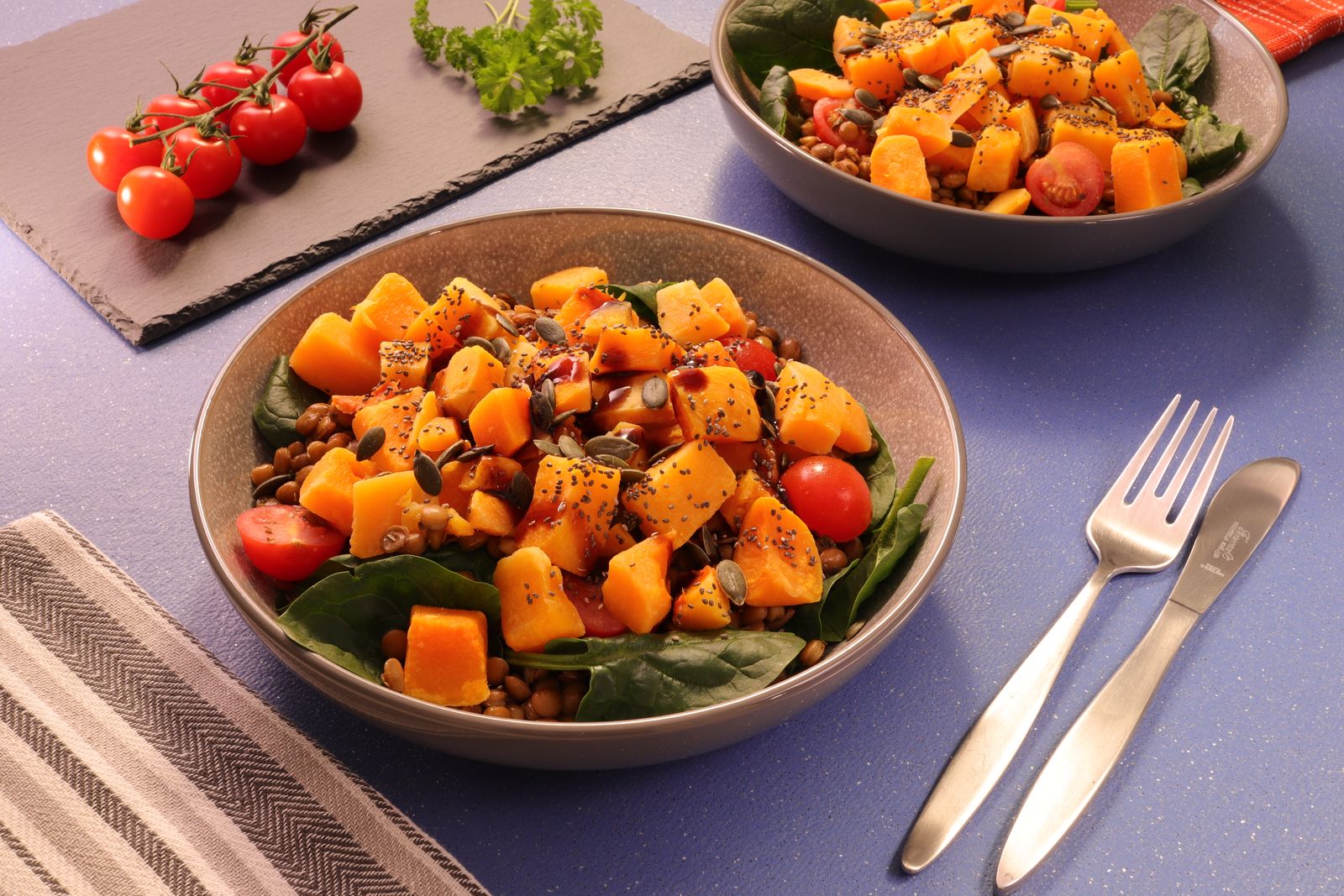
Fiber adds bulk to a meal.
How often people fall short
The 2020-2025 Dietary Guidelines for Americans say more than 90 percent of women and 97 percent of men do not meet recommended intakes for dietary fiber. The same page says fruits, vegetables, and whole grains are eaten below recommended amounts by more than 85 percent of adults. The guidelines connect low fiber intake with those patterns (U.S. Department of Agriculture and U.S. Department of Health and Human Services, 2020).
Those figures are about groups of adults. They are not a reading of one person's plate.
What one review found
Reynolds and colleagues (2019) brought together 185 studies that followed people over time and 58 clinical trials. They left out studies of people who already had a chronic disease and trials that used supplements.
In the follow-up studies, the highest fiber intakes lined up with a lower rate of early death and of several chronic conditions in the wider population (15 to 30 percent lower in the review).
What this does not settle
No source cited here names one plate that is right for every person. A group result is not your result. This article does not recommend a product or an amount of fiber to eat.
This is general education, not advice for you. It does not diagnose, treat or recommend anything for your situation. Talk with a licensed clinician about what applies to you, especially before changing anything if you have an existing condition or take medication.
References
- U.S. Department of Agriculture and U.S. Department of Health and Human Services. Dietary Guidelines for Americans, 2020-2025. 9th edition. December 2020.
- MedlinePlus. "Fiber." MedlinePlus Medical Encyclopedia. Editorial update September 15, 2026.
- Reynolds A, Mann J, Cummings J, Winter N, Mete E, Te Morenga L. "Carbohydrate quality and human health: a series of systematic reviews and meta-analyses." The Lancet, 2019.
These are public, peer reviewed sources about the underlying physiology. They are not studies of SiriusRx and they do not describe results anyone should expect from us.